Welcome to Suzhou Yiwang Weaving Co., Ltd.!
 CN
CN
Suzhou Yiwang Weaving Co., Ltd.
3D Breathable Elastic Spacer Fabric Mesh Weaving
 13915456816
Home Textile Fabrics: Overview of Structural Composition and Application Properties of 3D Mesh Fabri
source:www.cnyiwang.com.cn | Release time:2026年09月11日Fabric selection for home soft furnishings directly affects the tactile performance of finished products in daily use. Products such as mattresses, sofa cushions, throw pillows and seat cushions have specific requirements for fabric breathability and resilience. Traditional dense fabrics tend to trap heat and retain moisture inside, leading to a stuffy and humid feeling after prolonged use. As a textile fabric with a three-dimensional structure, 3D mesh fabric features hollow interlayers formed by a special weaving method, and is widely applied in home soft cushion applications. Our company specializes in the weaving and production of 3D mesh fabrics. We can produce three-dimensional mesh materials in various specifications and supply fabrics for manufacturers of home soft goods.
3D mesh fabric is integrally woven with an upper mesh layer, a lower mesh layer and connecting filaments in between, forming an integral three-dimensional hollow interlayer structure. The surface mesh features regularly arranged openings, and the intermediate connecting fibers vertically support the two fabric layers to deliver stable three-dimensional thickness. Fabric thickness can be adjusted via weaving processes to produce grey fabrics of different heights for the filling design of various soft products. The three-layer integrated weaving eliminates the risk of delamination caused by multi-layer lamination, maintaining a continuous overall structure.
The hollow three-dimensional structure creates interconnected air passages inside the fabric, allowing free air flow through the interlayers and removing accumulated moisture from contact surfaces. Sweat and heat generated by human contact with the fabric can dissipate outward through mesh openings, reducing moisture retention inside the material. This structure also endows the fabric with cushioning properties. When compressed by external force, the intermediate connecting fibers deform. Once the force is removed, the fibers gradually revert to their original shape, preserving the fabric thickness and resisting permanent collapse under long-term pressure.
The fabric is fully washable. Water can penetrate the surface meshes into the interlayer to flush away stains. After rinsing, the hollow space facilitates fast water evaporation, resulting in a short drying time and low tendency to develop odors. The material resists moisture damage and maintains stable dimensions in high-humidity environments, making it suitable for home products used in humid southern regions. No adhesive layers are added during weaving, so washing will not cause adhesive dissolution or fabric delamination.
Mesh patterns and opening sizes on the fabric surface can be customized to create diverse textures for different product designs. Styles with fine mesh textures are suitable for sofa covers and pillow fabrics. Large-opening variants prioritize ventilation and are commonly used for mattress inner covers and tatami underlays. The fabric can undergo secondary processing such as cutting and sewing. Cut edges are not prone to extensive yarn fraying, which simplifies cutting and sewing operations for downstream manufacturers and accommodates automated cutting lines.
Beyond home soft furnishings, this fabric can also be used for seat cushions, pet mats, medical brace linings and other products. Fabric grades with corresponding thickness and firmness can be selected for different application scenarios. Low-thickness fabrics are soft and ideal for body cushions. Thicker fabrics provide stronger support and are used for load-bearing applications such as mattresses and tatami pads.
Our company owns complete production lines for weaving 3D mesh fabric and can manufacture grey fabrics in various weights and thicknesses with custom dyeing options. After production, fabrics undergo basic visual inspection to check for broken filaments and uneven pores. Small roll samples are available for customer evaluation of fabric thickness and hand feel before mass production. Fabrics are packed in rolls and wrapped with plastic film externally to prevent dust and moisture during storage and transportation and ensure good condition upon delivery. We can schedule production according to downstream manufacturers’ order cycles to ensure stable fabric supply and provide textile support for all types of soft goods production.
prev:
Appearing at Industry Exhibition: Suzhou Yiwang W…
next:
What are the characteristics of 8D gray white spl…
【Related articles】
【Related products】


+
 WeChat ID:WANGYUNHUA
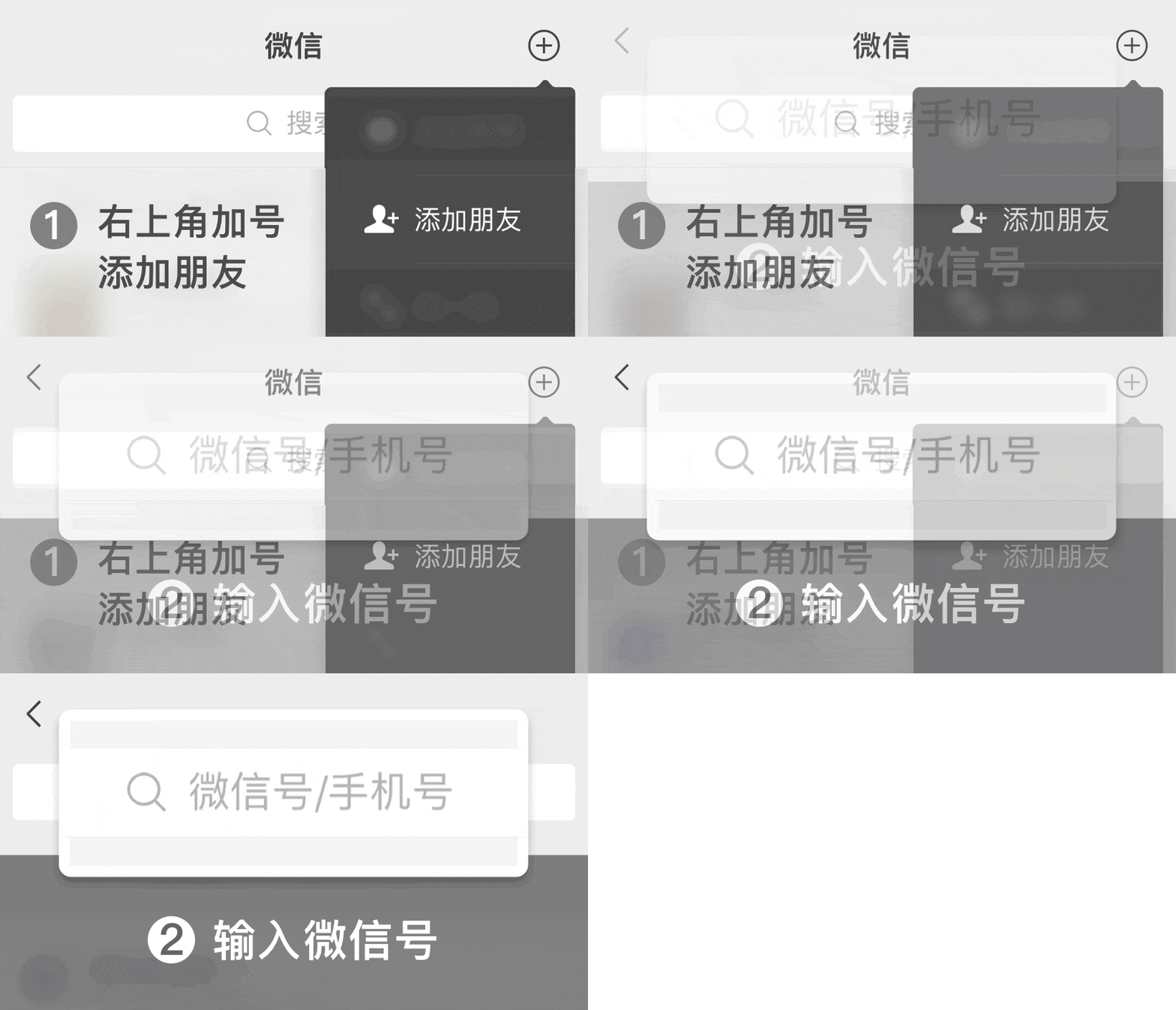
WeChat ID:WANGYUNHUA
-
 Scan QR to learn more
Copyright © 2023 Suzhou Yiwang Weaving Co., Ltd. All Rights Reserved www.cnyiwang.com.cn 苏ICP备2023016137号-1  苏公网安备32058102002507号 Technical Support:Lange
苏公网安备32058102002507号 Technical Support:Lange  添加微信
添加微信
 联系我们
联系我们
 电话咨询
电话咨询